How Long Does It Take for a Rabbit to Be Fertile Again After Hot Weather?
The selection of convenance buck and doe is very much important aspect of convenance since expert progeny is expected from good buck and doe. One has to consider the convenance stock in terms of fertility, maternal instinct, milk yield, growth rate, fecundity and viability.
Choice of Convenance Stock
(a) Cadet
The male rabbit is known as buck. A buck develops its breeding capabilities at the age of viii months. An ideal buck should continue to maintain its reproductive ability at least for 2 to 3 years. A young cadet may be immune to mate one doe at an interval of iii to 4 days. But, from 12 months of age onwards information technology may mate 4-half-dozen does in 7 days. A buck beyond vi years of age should be culled since semen quality declines. In society to keep the buck healthy additional protein, vitamin and minerals are to exist supplemented in diet. Ii breeding bucks should non exist kept in aforementioned place as they will fight each other and cause injury.
(b) Doe
The female rabbit is known as doe. A doe should have the perfectability to reproduce. A doe becomes capable to reproduce based on breed,nutritional condition and seasons. The smaller breeds attain sexual maturity earlier than larger breeds. A small breed may accept mating at iii-four monthsof age whereas the larger brood may accept mating at 8-nine months of age.A doe tin can exist used for breeding up to the historic period of 3 years and culling shouldbe made afterwards.
Reproduction
(a) Ovulation
The rabbit belongs to a grouping of mammals which practice not ovulate spontaneously. In that location is no oestrus cycle. Ovulation requires stimulus of mating and thus induced in nature. Sexual stimulation with copulation or in response to exogenous, gonadotropins, ovulation takes place. Sometime females may stimulate each other to the signal of stimulation. This type of ovulation is expected in does becoming pseudo pregnant or sterile for few days. Ovulation is apt to occur within the range of nine-13 hours. But, by and large it takes place at ten hours following mating.It is thought that does may remain in constant heat throughout the yr or in breeding season. But, it is known that follicles develop and regress in cycles of 15-16 days. There is a lack period when the doe may loose interest for the buck. Ovulation can also exist induced through mechanical stimulation of vagina.
(b) Mating A doe whether is in rut condition or not is difficult to recognize outwardly. Simply, does may show some manifestations like restlessness, nervousness, rubbing of head and chin on the side of the cage or other objects. The vulva becomes swollen and purple in colour. But, acceptability of the does to the bucks or does reaction to bucks should be taken equally a criteria for heat. Therefore, detection of oestrus through cadet should be fabricated before allowing for copulation.
The judge age of beginning mating is around 5-6 months of age. Equally a dominion doe should be taken to the cage of buck but never be done vice versa to avert fighting. Early morning and early evening are the nigh conducive time for mating. A receptive doe will elevator her tail and allow mating. Males vary greatly in their sexual bulldoze. A cadet may exist slow in performing the service to a strange cage. If a cadet is virile and doe in perfect heat, mating volition occur about immediately. Subsequently successful mating the cadet usually produces a typical cry and falls down to one side of the doe. 1 mating is usually sufficient. If a female does not allow in that case keeper should wait for 3 to 4 days or assist in mating holding the female. Later mating the doe should be returned to her muzzle.
In a commercial rabbit farmers would like to have five or six litters per doe per yr. This is possible only by weaning the litter at 5 weeks of age and mating the doe immediately following weaning. Each breeding cycle volition take 65 to 75 days. This can also exist achieved by mating the doe 21 days later on kindling.
(c) Pregnancy
The gestation (pregnancy) period in rabbit ranges from 28-32 days (approximately 30 days). The nest box is to exist kept inside the cage to facilitate the doe for preparing bedding for the new built-in. The nest is to be provided at to the lowest degree 5-6 days before parturition. The nest box should comprise nesting materials like harbinger, grass, woods savings etc. Saw dust should non be used as bedding material. A doe may pullout some of her ain hairs to brand nest for litters. Adequate measures should be taken concerning feeding and management during pregnancy period. Quantity of feed should be increased for x to 15 days of pregnancy. Plenty of fresh water should be provided.Environmental stresses should be avoided every bit far as possible.
Pregnancy tin can be detected by various methods: (a)Through palpation of abdomen by which embryos can be felt by hand. This is best done at about ii weeks after mating. This technique can be perfectly done through experience. (b)Placing the buck near the doe for mating. A cadet may not mate the pregnant one. (c)Uterine swelling-uterus may swell upwardly to 12 mm at 9 days after mating. It may reach 20 mm at 13 days. Just experienced keeper may be able to predict the changes accurately. (d) Changes in body weight-In that location are pregnant change in trunk weight from mating up to thirty days. Average gain of around 300-400 gm has been suggested from mating to xxx days in big sized rabbit.
(d) Kindling (Parturition) Procedure of giving nascence of new baby of rabbit is known as kindling. It is a natural physiological miracle. The parturition very often takes place at late night or early morning. Information technology may non require any interference past the keeper. The procedure unremarkably completes within 7-thirty minutes. Sometime all the litters may not be built-in on succession. Some may born after several hours or a solar day. The pregnancy may required to be terminated through injection of oxytocin. Following parturition the does used to lick the young and may swallow the placenta. The babe rabbits will try to suckle the mother. If the number of litter is viii, all may be able to suckle since doe has 8 teats. The infant rabbits those will be unable to suckle may plough weak and susceptible to diseases. Many of them may even die prematurely. The does should not be disturbed during this time and be fed advertisement lilbitum. Adequate food and h2o should be provided so that optimum amount of milk is bachelor to the baby rabbits. Rabbit used to nurse her immature commonly at night or early morning only for once. vi-12 baby kids may be barn from a single kindling.
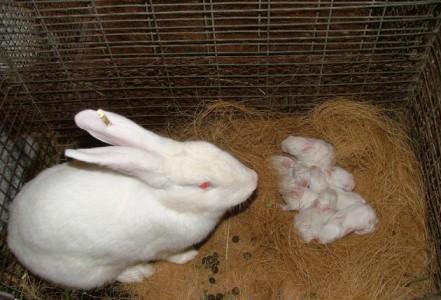
(eastward) Weaning
Immediately following nativity baby rabbits are solely dependent on their mother. They are born naked. Just at about 7 days, there is growth of pilus and vitality of them. The optics used to open afterward ten days. The baby rabbits tin can pb their lives without mothers' milk at virtually 21 days of historic period. The immature should exist removed from their mother not before 4th week. The doe should exist removed from the cage. Foods like concentrates and grasses should exist provided. The baby rabbits can chew and eat after three weeks of age. The does can be rebred provided the physical conditions of them are satisfactory in nature after 1 week of kindling.
(f) Identification of Sexual activity (Sexing)
Sexing is done at the fourth dimension of weaning. The baby rabbit has to be placed on the hand and by the pressure of pollex and forefinger the sex organ is to be pushed on either side. In case of buck the penis will come out as a protruded mass having rounded tip. But, a slit volition be located in instance of Doe.
(Source: Namakkal KVK, Rabbit Farming)
Stage-wise description of reproductive stages in rabbit
| Breeding males required | 1 male person for 10 females |
| Historic period at which first bred | Small breeds - iv months historic period (Polish, Dutch) Medium breed - v to 6 months (Newzealand White, Chinchilla) |
| Characteristics of reproduction | Polyoestrous. A female rabbit appears to have no definite oestrus cycle although a certain rhythm exists in their sexual receptivity. Cycle lasts for about 12 days of which 4 are infertile. |
| Signs of heat | Congested, royal and moist vulva, restlessness, rubbing the chin on the sides of the cage, lying in mating posture and lifting the tail |
| Mating behaviour | The doe is always taken to the buck's cage for mating, and if the doe is in total sexual receptivity it will elevator the tail and within a minute the buck will exist mating the doe. Mating is successful when the buck falls to one side or backwards subsequently mating |
| Ovulation | Ovulation occurs 10 - thirteen hours after copulation – reflex ovulation |
| Pseudo pregnancy/ | Pseudo pregnancy in rabbit may outcome from sterile copulation and lasts for 16 to 17 days. At the end of this menses she may pull hair from her trunk and effort to make nest and shows evolution of uterus and mammary gland. |
| Gestation period | 28 -34 days (average 31 days) |
| Pregnancy diagnosis | The methods adopted to determine the country of pregnancy are test mating, weight gain method and the 'palpation technique'. The palpation technique is the nigh reliable method if done by an experienced person. |
| Palpation technique | A completely relaxed doe should be placed on a table which has been covered in sacking to forbid her from slipping. The doe should exist restrained by gently property the fold of skin behind ears and over the shoulders. The left hand is placed under the body between the hind legs and in front of the pelvis. The uterine horns are felt gently using fingers and thumb. The thumb is placed to right of horns. Embryos tin can exist located and felt like pocket-sized marble shaped bodies slipping backwards between thumb and fingers when moved gently in a sideways management. An experienced person can deter-mine pregnancy by 8th to tenth mean solar day of mating using this technique. During last calendar week of pregnancy a nest box lined with woods shaving or hay or coir fibre should be placed within the cage. |
| Litter size | vi-8 kits |
| Weaning | four-6 weeks |
| Kindling interval | 2 months (information technology may be as short as one month if bred immediately following kindling) |
(Source: www.vuatkerala.org )
© 2009-15 TNAU. All Rights Reserved.
Source: https://agritech.tnau.ac.in/animal_husbandry/animhus_breeding%20of%20rabbit.html
0 Response to "How Long Does It Take for a Rabbit to Be Fertile Again After Hot Weather?"
Post a Comment